Tic Tac Toe Is Two Thousand Years Old. The Newest Version Has Synthwave.
A short history of tic-tac-toe — from the Roman game Terni Lapilli to the 1952 EDSAC computer game OXO to the new Neon Tic Tac Toe game on FunClicker.
Most people learn tic-tac-toe before they learn to spell it. It's the first game most kids draw on a piece of paper. It's the first game a lot of people teach their children. It's also one of the oldest games still played on Earth.
The game's earliest known ancestor is a Roman three-piece grid game called Terni Lapilli, the Latin name for "three small stones." Romans played it on stone slabs scratched into floors and walls across the empire — archaeologists have found Terni Lapilli boards at Hadrian's Wall in northern England, the ruins of Pompeii, and several sites along the Mediterranean. The Roman version had a small twist over the modern game: players couldn't add stones once all three were on the board. Instead, they slid an existing stone to an adjacent square, which means the game was less about marking territory and more about positional pressure. It was a game of patience.
The British name noughts and crosses first appears in print in the early 19th century, in a London children's games book that described it as a school slate game. The American name tic-tac-toe has a stranger origin — it comes from a separate bingo-adjacent game where players threw beans at a numbered grid and shouted "tic, tac, toe" when they marked a winning row. The name slowly migrated to the pencil-and-paper grid game over the 20th century, eventually replacing the older American name "tit-tat-toe."
The first computer version of tic-tac-toe was written in 1952. Alexander Douglas, a PhD student at Cambridge University, built a game called OXO for the EDSAC computer as part of his thesis on human-computer interaction. It's widely cited as one of the first video games ever built. OXO predates Spacewar by ten years and Pong by twenty. It also played a mathematically perfect game, which made it the first computer that couldn't be beaten at tic-tac-toe.
That mathematical perfection is why tic-tac-toe has the reputation it has today. On a standard 3×3 board, two players who both play perfectly always draw — the game has been formally proven solved since the 1960s. This is why most people stop playing tic-tac-toe somewhere around age nine. Once you understand the pattern, the game is over.
The way you make tic-tac-toe interesting again is to break the 3×3 constraint. The 19th-century Japanese game Gomoku does this by playing five-in-a-row on a 15×15 board, where the tactical possibilities open up to something closer to chess. Modern variants pull the board size somewhere in between — 4×4 and 5×5 boards with four-in-a-row win conditions, which keep games fast while making perfect play impossible.
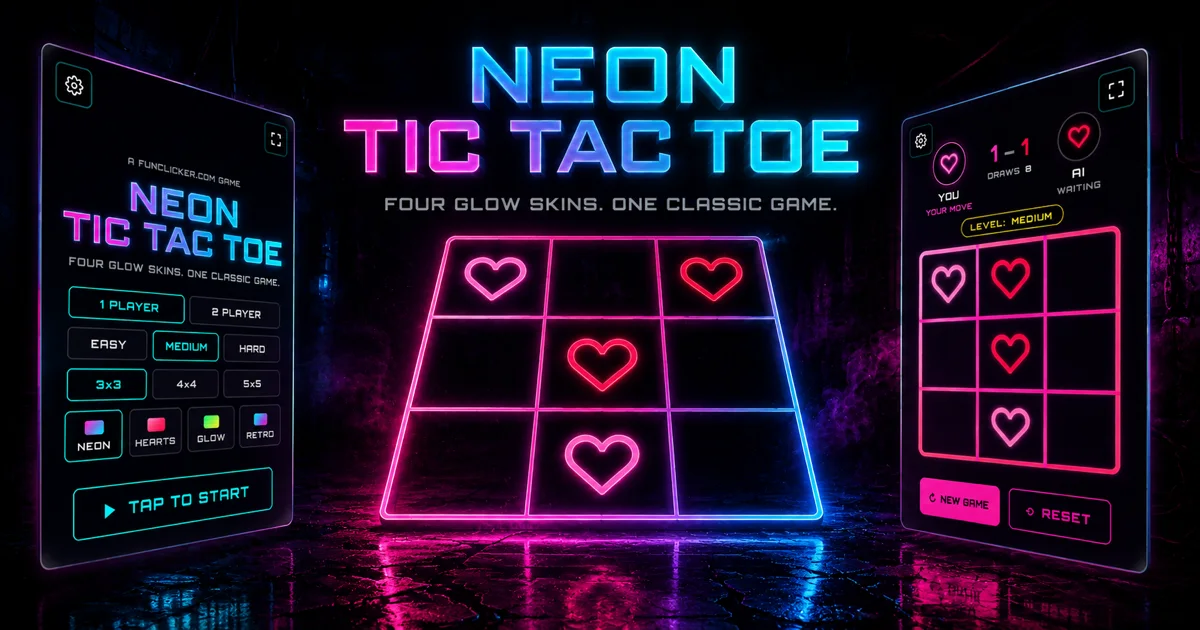
The Neon Tic Tac Toe game we launched this week takes this same approach. It ships with three board sizes — 3×3 for the classic experience, 4×4 and 5×5 for the harder games. It also ships with four switchable visual skins, which is the part of the game that wasn't possible in 79 AD: a synthwave skin with a neon grid floor that wouldn't have made sense to a Roman scratching stones into a wall, but that makes a lot of sense to anyone who grew up with arcade machines.
Tic-tac-toe doesn't change. The medium does.
